

It takes a longer time to avail of these loans, owing to tight due-diligence process of banks.

Factory production expanded by 1.7 per cent on an annual basis in February on account of improved performance by the mining and power generation sectors, as per government data released on Tuesday. The Index of Industrial Production (IIP) had contracted by 3.2 per cent in February 2021. The growth was 1.5 per cent in January 2022. As per the data released by the Ministry of Statistics and Programme Implementation, the growth in the mining sector was 4.5 per cent against a contraction of 4.4 per cent in February 2021.

The adverse impact on the margins of auto, consumer staples and consumer durables sectors will be counterbalanced by an earnings uptick in the metals, cement and oil & gas sectors.

Automotive (auto) and consumer appliance companies are hoping for a bounty from the harvest season after two consecutive dry spells in 2020 and 2021. The season, which also marks the beginning of the regional New Year, kicked in across the country from April 1 - Gudi Padwa in Maharashtra; Ugadi in Karnataka, Telangana, and Andhra Pradesh; Bihu in the Northeast; and Chaitra Navratri in the North. Manufacturers and retailers of cars, two-wheelers, and consumer appliances said they have seen demand pick up year-on-year (YoY) at a brisk pace across categories.

From the Sensex pack, IndusInd Bank, NTPC, Asian Paints, Hindustan Unilever, JSW Steel, Tech Mahindra, Bajaj Finance, Infosys, Wipro, ICICI Bank, Bajaj Finserv, HDFC Bank and Tata Motors were among the major laggards. HCL Technologies, Power Grid, Titan, Reliance Industries, UltraTech Cement, Tata Steel, State Bank of India and Mahindra & Mahindra were the gainers.
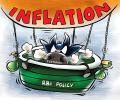
The Reserve Bank on Wednesday retained the retail inflation projection at 4.5 per cent for fiscal 2024-25, with Governor Shaktikanta Das stressing that the central bank will have to closely monitor the price situation and keep the "inflation horse" under tight leash lest it may bolt again. Unveiling the October bi-monthly monetary policy, the Governor also said the flexible inflation targeting (FIT) framework has completed 8 years since its introduction in 2016 and is a major structural reform of the 21st century in India.

CEOs have complained that high interest rates have blocked their investment decisions. At the same time, customers are also deferring their purchases for new consumer durables, cars, and homes.
The S&P BSE Sensex closed 96 points down at 25,105.51 while the CNX Nifty ended 29 points down at 7,511.45.

Capital goods output rose by a robust 20 per cent in the month under review as against a contraction of 2.4 per cent earlier.

'The central bank has highlighted that the slowdown in growth has been limited to a few sectors and overall growth is expected to pick up in the second half of the year.'

Investors became richer by over Rs 2.27 lakh crore on Monday as equities rebounded, with the BSE Sensex rallying over 1 per cent amid continuous foreign fund inflows and upbeat global markets. The 30-share BSE Sensex jumped 709.96 points or 1.16 per cent to settle at 61,764.25. During the day, it zoomed 799.9 points or 1.31 per cent to 61,854.19. Following the rally, the market capitalisation of BSE-listed firms jumped by Rs 2,27,794.46 crore to Rs 2,76,06,443.06 crore.
Shares of metal, realty, consumer durables, auto, capital goods and banking hogged limelight on a flurry of buying by investors

Spiralling prices pinched the pocket of consumer as edible oil, fuel and many other commodities turned dearer this year amid pandemic-induced disruptions but the inflationary pressure is anticipated to ease, though marginally, in the coming months. As consumers, at retail as well as wholesale levels, are willy-nilly learning to live with the new normal of curbs to contain the spread of coronavirus infections, experts are of the view that elevated inflation is likely to stay longer. After dealing with the devastating blows from the second COVID wave, especially during the April-June period, the economy is well on the revival path but the emergence of Omicron might unsettle the recovery trajectory in the short term.

In the last few years, zero per cent financing has become quite attractive as consumers aspire to buy the latest products, especially in categories such as mobile phones and television sets.

'The RBI's MPC will maintain the current policy rates (6.50%) at the policy meeting, given ongoing inflationary pressures.'

The rates of price rise in many services used by the common man, including hospital and nursing, cook, domestic help and bus (fare), among others, have also touched double digits during the last four years, putting a burden on disposable income.

Almost 40 per cent of a durable company's sales are achieved during the festival season
Finance Minister P Chidambaram presented the Interim Budget for 2014-15 on Monday. Income Tax rates were kept unchanged.
Finance Minister P Chidambaram on Monday slashed excise duty on cars, SUVs and two-wheelers, and capital goods and consumer durables.

'Investment creates capacity and reduces inflation. Income, employment, and savings rise.'

The government clarified that the majority of industrial establishments had reported nil production, and cautioned that the numbers should not be compared with those of previous months. "It is not appropriate to compare the IIP of April 2020 with that of earlier months, and users may like to observe the changes in the IIP in the following months," said the ministry of statistics & programme implementation.

Retailers in the food, grocery and fashion retail segments to be unaffected

Consumer Electronics and Appliances Manufacturers Association Consumer has also welcomed the move saying the it would improve the sentiments and strengthen the growth.

Continuing its decline for the third day on Friday, the BSE gauge plummeted 1,214.96 points or 2.20 per cent to 53,887.72 during the day. It settled at 54,333.81, a decline of 768.87 points or 1.40 per cent.

Among major Sensex shares, PowerGrid fell the most by 2.76 per cent. IndusInd Bank dropped 2.34 per cent, HUL by 2.23 per cent and NTPC by 2.04 per cent. ICICI Bank, HDFC Bank, HDFC, ITC, Infosys, L&T, Bajaj Finance, Kotak Bank, HCL Tech and Tech Mahindra were among the losers. On the other hand, Tata Motors rose the most by 2.94 per cent, followed by Titan which gained 1.26 per cent. Mahindra & Mahindra, SBI and TCS were also among gainers.
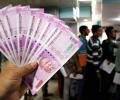
These sectors are seeing a marked slowdown, as consumers are postponing purchase decisions amid uncertainty and severe cash crunch, report Ram Prasad Sahu, Sheetal Agarwal & Ujjval Jauhari from Mumbai.
India's industrial production contracted by 4 per cent in October, the sharpest fall in 26 months, mainly due to decline in output of manufacturing and subdued performance of mining and power generation sectors, according to official data released on Monday. The Index of Industrial Production (IIP) had grown 4.2 per cent in October 2021. The previous low was (-) 7.1 per cent in August 2020.
Harshala Chandorkar of CIBIL offers tips on how to keep your finances intact and shop smart this festive season.

Customers are increasingly preferring to pay through EMIs while buying high-value consumer items, as affordability has become a key factor in the post-pandemic scenario, payments solution provider Ezetap said on Thursday. Buying ability of consumers across the country has been significantly reduced due to the pandemic. They are either avoiding a single big payment or entirely skipping to buy any new item, Ezetap said.
P Chidambaram presented the Budget for the 9th time.
Gains were led by realty, auto, capital goods, banking, infrastructure, metals, power, oil & gas, PSU and consumer durables sectors, which rose up to 3.30 per cent.

'Try to obtain a secured personal loan or credit card by offering some collateral, such as a fixed deposit or gold.' 'Not only will this improve your eligibility, but the lender may even offer a lower interest rate.'

'Rhetoric and chest-thumping are running high on India's recent growth record.'
'But will the giant waves developing elsewhere allow us to sail smoothly into fair winds?' asks Debashis Basu.

Industrial production in May slowed to 2.7 per cent from 5.6 per cent a year ago, dragged down by manufacturing, strengthening the case for an RBI rate cut.
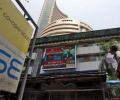
Equity benchmark indices Sensex and Nifty buckled under selling pressure after a nine-session rally on Monday, as massive sell-off in IT, tech and telecom counters unnerved investors.

The latest hike is likely to be followed by another such move next month, said industry players. Before the latest hike, companies had initiated price hikes to the tune of 12-13 per cent in 2021 but they weren't able to fully cover the increase in costs.

India's industrial production slipped to an 18-month low, contracting by 0.8 per cent in August, mainly due to a decline in output of the manufacturing and mining sectors, according to official data released on Wednesday. The data showed that the previous low in industrial output growth was a contraction of 3.2 per cent in February 2021. Factory output, measured in terms of the Index of Industrial Production (IIP), had expanded by 13 per cent in August 2021. The IIP grew by 2.2 per cent in July this year.

Equity investors became poorer by Rs 7.48 lakh crore in five consecutive days of market fall, where the BSE Sensex has declined by nearly 3 per cent. In the past five days, the BSE Sensex has tumbled 1,713.71 points or 2.79 per cent. This has led to an erosion of Rs 7,48,887.04 crore from the market capitalisation of BSE-listed firms in five trading sessions.
 © 2026 Rediff.com - Advertise with us - Disclaimer - Privacy Policy - Sitemap - Feedback - About us - Terms of use - Grievances